Confronting Genocide Never Again Stufy Guide Part 1
New! Stages of Genocide: A Toolkit for Educators
Studying genocide is a critical part of a pupil'south understanding of both history and of current events. The Stages of Genocide Toolkit is designed to help teachers cover the topic in a
meaningful and incisive way. Using the "Ten Stages of Genocide" framework provides (more…)
Survivor Objects: the Zeytun Gospels
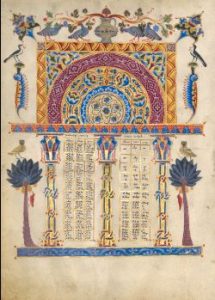
The Zeytun Gospels, an 800-year-onetime manuscript, survived the Armenian Genocide. Understanding the life of an object like the Zeytun Gospels illuminates the devastation of genocide. It also shows how justice, even in minor doses, tin be plant amidst the ruins left by genocide. (more than…)
Human Rights and Genocide: A Example Study of the First Modern Genocide of the 20th Century
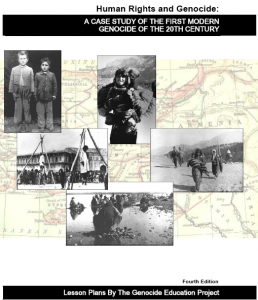
This comprehensive teacher'south manual focuses on the Armenian Genocide of 1915 during which i.5 million Armenians, half of the Armenian population, were systematically annihilated. It includes a i-twenty-four hour period, ii-mean solar day, and x-twenty-four hour period unit with all the materials teachers will demand, including more two dozen overheads, interactive classroom exercises and more.
Discussions include a broad range of topics related to the Armenian Genocide: the history of Armenians in the Ottoman Empire, primary source documents, witness and survivor memoirs, maps and political-economical timelines, and the problem of deprival.
(more…)
Two Day Lesson on the Armenian Genocide
This is a compressed version of The Genocide Education Projection'due south 10-day curriculum plant in Human Rights and Genocide: A Instance Report of the Get-go Modern Genocide of the 20th Century . Information technology is to exist completed in two fifty-minute class periods, with 2 homework assignments, i before and another between the lessons. The lesson includes the definition of genocide, historical background on the Armenian case, a review of other major genocides, a short national Television set news piece, and readings from survivor testimonies.
Finding a New Life: The Armenians of Watertown
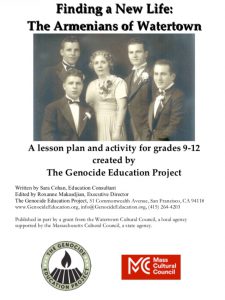
Finding a New Life: The Armenians of Watertown is an introductory unit of measurement providing a background to the history of the Armenian Genocide, the furnishings of the genocide on subsequent generations in Watertown, and universalizes the experience for other groups who take constitute condom haven in Watertown. Finding a New Life illustrates the continued pain and harm that genocide brings and the fortitude of those searching for the truth.
(more…)
THE Promise lesson plan: Concepts of Resistance

"Our revenge volition be to survive," says the character Ana to Michael in the feature picture show, The Hope . This lesson introduces students to the efforts by genocide victim populations to reply to the violence against them. Using the feature moving-picture show, The Promise , students are guided through readings, discussions, and exercises about the Armenian Genocide and the unlike forms resistance can take.
(more…)
THE PROMISE: pic study guide

The movie, The Promise, released in 2017, is the kickoff major Hollywood dramatic characteristic recounting the history of the Armenian Genocide of 1915, perpetrated past the Turkish government. The film provides a unique educational opportunity to empathise the greatest atrocity and human rights crisis of WWI. It also opens a window onto the German and American presence in the (more…)
The Other Side of Domicile
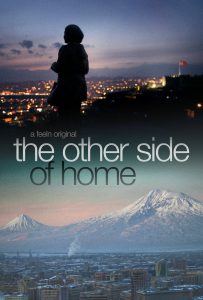
GenEd has created a discussion guide to accompany this compelling twoscore-minute documentary which explores a Turkish woman's discovery of her hidden Armenian heritage and the legacy of genocide denial. "The Other Side of Home" is at present bachelor to view through public library online streaming services, Kanopy, Hoopla, and Overdrive, using your public library carte number (If you don't have a card, many libraries now accept online library card applications.)
(more…)
Memorializing Genocide: A Tulip Garden
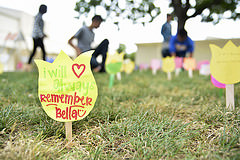
How should genocide be remembered? This lesson and action begins with a classroom discussion almost how communities remember major historical events, including human rights atrocities. Students besides learn the allegorical story of Armenian botanist JJ Manissadjian, who studied and catalogued a rare, wild tulip found in the Armenian homeland in pre-WWI Ottoman Empire. The tulip became extinct in the wild, but was cultivated later from seeds Manissadjian had sent to Europe. Manissadjian was imprisoned during the Armenian Genocide, but escaped and immigrated to Europe and the United States. The tulip story is symbolic of the fate of Armenians.
(more…)
X Stages of Genocide
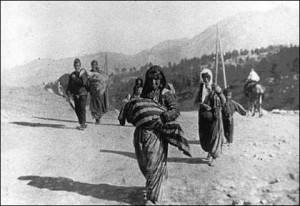
This teaching guide is based on genocide scholar Dr. Gregory H. Stanton'south work "X Stages of Genocide" (an update of his previous "Eight Stages of Genocide," 1996.) The progression of stages is a formula for how genocide is prepared, carried out, and produces long-lasting repercussions. Beginning with prejudice, genocide develops over fourth dimension, involving the cooperation of a big number of people and the land; This lesson helps students empathise genocide as a process that tin can be corrected and prevented.
Educator's Guide for "Similar Water for Stone" Novel
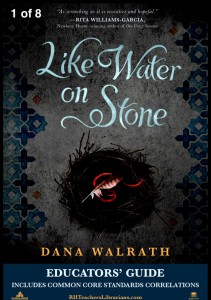
Like Water on Stone by Dana Walrath is fictional account of the Armenian genocide. This novel in poesy recounts the flight to America of three Armenian children after the Ottoman Turks confiscate their family's flour mill and murder their parents. For threescore-three days the children travel on foot, above the tree line of the Caucasus Mountains and through the Syrian Desert, to reach refuge in Aleppo, Syrian arab republic. Taken in by a sympathetic Arab shopkeeper, the children disguise themselves as Arabs to avoid beingness forcibly relocated to the Deir el-Zor concentration camp, where starvation and barbarity led to sure decease. After iii years in hiding, the children finally receive a letter and boat tickets to America from their keri (maternal uncle).
The volume's Educator'southward Guide was created for Random House by Judith Turner, a longtime educator at Terrace Community Middle School in Tampa, Florida. It includes pre-reading activities, discussion and activeness prompts and a list of Common Core Standards correlations.
They Shall Not Perish: The Story of Near East Relief
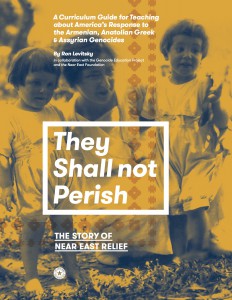
They Shall Not Perish: The Story of Near East Relief is a 32-folio curriculum
booklet on America's response to the Armenian Genocide, through the work of the Near East Relief foundation. NER workers courageously diameter witness to the genocide and fed, clothed, and provided medical treatment to thousands of refugees. Near East Relief is credited with saving over one one thousand thousand lives between 1915 and 1930, including 132,000 orphan children, in what was the largest international humanitarian effort up until that time.
(more than…)
An Armenian Journey: From Despair to Promise in Rhode Isle
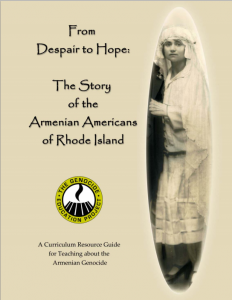
A curriculum resource guide and video documentary created by The Genocide Education Project in cooperation with the Rhode Island Quango for the Humanities. The Armenian Journey: From Despair to Hope in Rhode Isle provides a background to the history of the Armenian Genocide, the effects of the Genocide on subsequent generations, and universalizes the feel for other groups who have institute safety oasis in the United States. The video and resource guide illustrates and elucidates the continued pain that the enormous crime of genocide and its deprival brings, as well as the fortitude of those searching for truth. (more…)
The New York Times and the Armenian Genocide
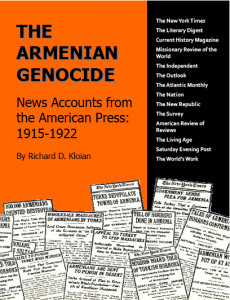
A Lesson Program based onThe Armenian Genocide – News Accounts from the American Printing, 1915-1922
This curriculum extracts articles from the volume, "The Armenian Genocide: News Accounts from the American Printing," compiled by Richard Kloian (available from GenEd and can be ordered for $25 by emailing). Including 200 New York Times manufactures, other journalistic accounts, U.S. Ambassador Morgenthau's personal business relationship of the genocide, survivor accounts, telegrams from the genocide perpetrator, photographs, and more than, the volume presents a compelling chronicle of the systematic deportations and massacres of the Armenians of the Ottoman Empire, perpetrated by the Turkish governing authorities between 1915 and 1922.
(more…)
iwitness Photo Activity
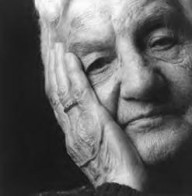
The iwestward itness photo documentary project was begun past artists Ara Oshagan and Levon Parian in 1995, when they began photographing and after interviewing survivors of the Armenian Genocide,
The photographs were commencement exhibited at the Downey Museum of Fine art in southern California in 1999, and later featured in the LA Times Sunday Magazine and many other venues. During the centennial celebration of the Armenian Genocide in 2015, the exhibit was re-made into a large-scale public art installation on 3 levels at the Music Centre and Grand Park in Downtown Los Angeles.
iwitness provides an ideal vehicle for middle-loftier schoolhouse students to explore first-person testimonies of the Armenian Genocide through an artistic, interpretive lens.
Voices of Survivors: The Armenian Genocide
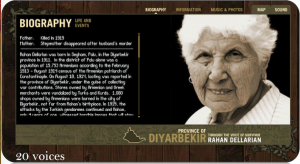
Utilizing the 20 Voices video past Araz Artinian and the 20 Voices of Survivors lesson program created by The Genocide Educational activity Project, this do allows students to get a glimpse of the historic homeland of the Armenians that was completely erased in only a few years, from 1915-1923. Students learn what survivors had, what was lost, and tin can begin to imagine the impact of this trauma on the rest of their lives. Teachers should email GenEd to request a free CD-Rom of the Interactive site, to exist used with the downloadable lesson.
(more…)
Genocide and the Human being Vocalisation: Nicole's Journey
This interactive online classroom provides students a background to the history of the Armenian Genocide and the effects of the deprival of the Genocide on subsequent generations. Nicole's existent life journey to the village of her grandmother, now in Eastern Turkey, illustrates the continued pain that genocide brings and the fortitude of those searching for truth.
(more…)
Crimes Against Humanity and Civilization: The Genocide of the Armenians
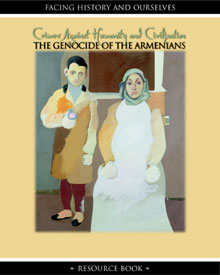
FROM FACING HISTORY AND OURSELVES:
Facing History's resource book, Crimes Against Humanity and Culture: The Genocide of the Armenians, combines the latest scholarship on the Armenian Genocide with an interdisciplinary approach to history, enabling students and teachers to make the essential connections between history and their own lives. By concentrating on the choices that individuals, groups, and nations made before, during, and later on the genocide, readers have the opportunity to consider the dilemmas faced by the international community in the face of massive human rights violations.
(more…)
The Armenians: Shadows of a Forgotten Genocide
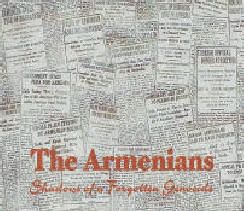
Published by the Holocaust Resource Middle and Athenaeum, Bayside, New York for its 1999 Armenian Genocide exhibit, this 23-page booklet includes a brief history on the Armenian Genocide, news coverage, maps, the continuing Turkish government denial, and discussion questions.
Contact The Genocide Education Project for the booklet.
The Armenian Genocide, 1915 – 1923: A Handbook for Students and Teachers
Prepared by the Armenian Cultural Foundation
Nearly the Author: Simon Payaslian holds a Ph.D. In political science (Wayne State Academy, 1992) and is a Didactics Fellow and Ph.D. Candidate in the Department of History at University of California, Los Angeles (UCLA).
This handbook provides both a historical perspective of the Genocide and an overview of international and national constraints in preventing the genocides that followed, highlighting the earth'due south disability to deal appropriately with the perpetrators of the Armenian Tragedy.
This volume as well provides teachers with maps, graphs, and eyewitness accounts besides as valuable teaching aids such as the worksheets, word and essay topics to maximize the educatee'south understanding of how the unspeakable can occur and recur even in contemporary times.
[simpleecommcart_add_to_cart id="three" ]
Model Curriculum For Homo Rights and Genocide
Published for the California State Board of Education
past the California Department of Pedagogy
ISBN 0-8011-0725-iii
This Model Curriculum for Man Rights and Genocide, which serves equally a guide for classroom teachers, supports the curriculum and instruction described in the framework. Pages 1-5 of this document contain a model that can exist used past developers of curriculum. This section provides the philosophical bases for including studies on man rights and genocide in the curriculum, identifies places in the history-social science courses where learnings can be included, and poses questions that volition appoint students in critical thinking on this topic.
(more…)
Teaching the Armenian Genocide: Resource for Teachers, Students and Educators
Published by the Armenian Genocide Resource Center (AGRC) of Northern California
This resource guide lists books, teaching guides, inquiry reports, monographs, archival documents, bibliographies, photographs, websites, videos, and maps available on the Armenian Genocide.
Confronting Genocide: Never Once more?
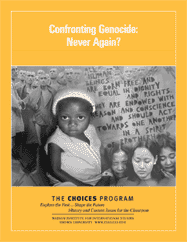
FROM THE CHOICES Plan:
Overview of the Unit – The genocides of the twentieth century elicited feelings of horror and revulsion throughout the globe. Yet both the international community and the U.s. have struggled to respond to this recurring problem.
(more…)
Source: https://genocideeducation.org/resources/teaching-guides/
0 Response to "Confronting Genocide Never Again Stufy Guide Part 1"
Post a Comment